MuleSoft vs Boomi vs SnapLogic & iPaaS Alternatives (2026)
MuleSoft and Boomi are the two names that come up first in almost every enterprise integration shortlist, and the question is rarely just which one of the two to buy. Buyers compare them against SnapLogic, TIBCO, Oracle Integration Cloud, Informatica, and Workato in the same breath. This guide explains what MuleSoft and Boomi are, how they differ, and where the alternatives win. In our dataset of over a million job postings, MuleSoft shows up far ahead of Boomi, which tells you which platform companies are building the deepest teams around.
MuleSoft vs Boomi compared, plus how they stack up against SnapLogic, TIBCO, Oracle OIC, Informatica, and Workato. Pricing, fit, and hiring-demand data.
What MuleSoft and Boomi Are
Both are Integration Platform as a Service (iPaaS) products. They connect business applications so data moves between them without someone copying records by hand. Sync Salesforce with your ERP, push orders into a warehouse system, expose a clean API on top of a legacy database.
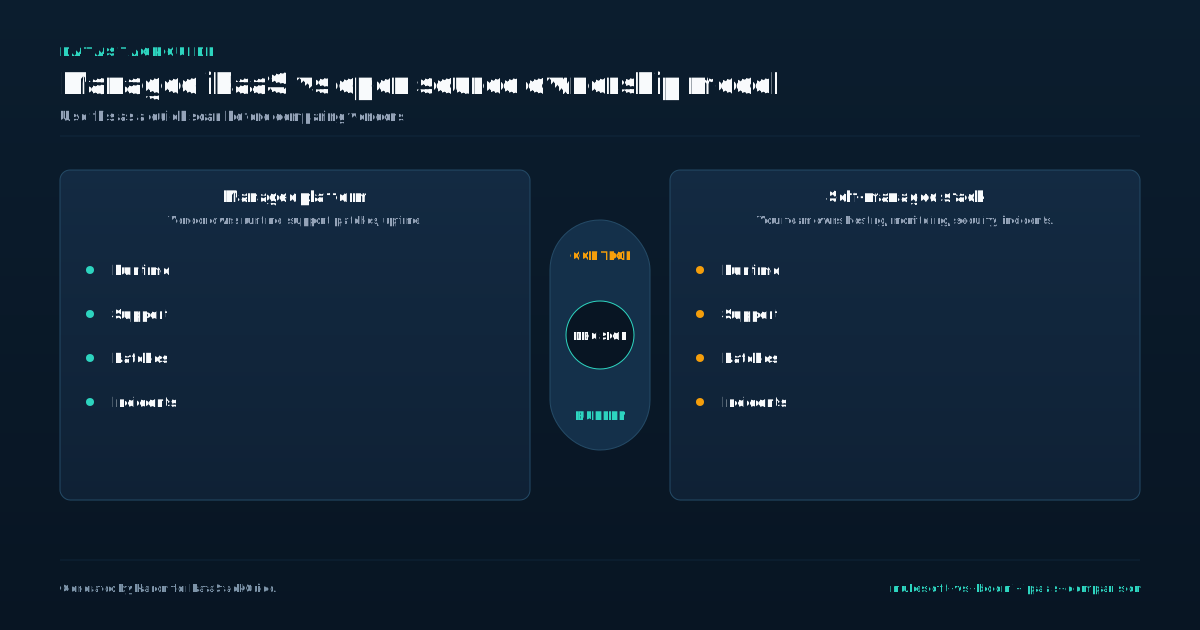
- MuleSoft, owned by Salesforce since 2018, is built around Anypoint Platform and an API-led philosophy.
- You design reusable APIs, manage them in a central registry, and compose integrations from those building blocks.
- It is powerful and it assumes you have developers.
That is the job. The learning curve is real. Boomi (spun out of Dell, now independent under Francisco Partners) takes a lower-code path. Its AtomSphere designer leans on visual flows and prebuilt connectors so integration specialists, not just senior engineers, can ship work.
It trades some of MuleSoft's API-management depth for faster time to first integration. The short version: MuleSoft is the API-led heavyweight for organizations standardizing on Salesforce and building an API program. Boomi is the faster-to-deploy generalist for teams that want broad connectivity without a large engineering investment.
MuleSoft vs Boomi Head to Head
Pricing is where most evaluations stall, because neither vendor publishes clean numbers. MuleSoft sells by 'cores' (compute units) and the entry point for a serious deployment commonly lands in the a premium negotiated annual budget once you add cores, API management, and support.
- Boomi prices by connections and environments, and real deployments often start lower, in the a lower but still negotiated annual budget, though heavy connector counts push it up fast.
- On capability, MuleSoft pulls ahead for full API lifecycle management, high-throughput transactional integration, and complex transformations through DataWeave.
- Boomi pulls ahead on speed of delivery, breadth of prebuilt connectors, and master data management, which it bundles rather than selling separately.
The hiring data is the tiebreaker most buyers miss. MuleSoft has a significantly deeper talent pool than Boomi in our dataset. That means easier hiring, more agencies who know the platform, and lower implementation risk. If you cannot staff a tool, its feature list does not matter.
For the full side-by-side with pricing tiers and pros and cons, read our dedicated Boomi vs MuleSoft comparison.
MuleSoft & Boomi vs SnapLogic
SnapLogic positions itself between MuleSoft's developer depth and Boomi's accessibility, with a visual pipeline builder it calls Snaps and a heavy push on AI-assisted integration. Teams pick it when they want strong data-pipeline and analytics integration alongside app-to-app work, since it straddles iPaaS and data integration better than MuleSoft does out of the box.
- SnapLogic appears in only 19 of our job postings, against 784 for MuleSoft and 178 for Boomi.
- The product is capable, but the talent market and partner network are far thinner, which raises hiring and support risk.
- SnapLogic vs MuleSoft vs Boomi usually comes down to whether SnapLogic's data-and-app blend solves a specific problem the other two handle awkwardly.
The caution is ecosystem size.
How TIBCO, Oracle OIC, and Informatica Compare
These three show up most often when the buyer already runs a matching enterprise stack. TIBCO (now part of Cloud Software Group) is the legacy enterprise integration veteran, strong in high-volume messaging, event processing, and on-premises environments. Companies with heavy real-time event needs or a long TIBCO history compare it to MuleSoft and Boomi.
- It is rarely the choice for a greenfield cloud-first team.
- Oracle Integration Cloud (OIC) is the natural pick if you are deep in Oracle Fusion, ERP Cloud, or NetSuite.
- Its prebuilt adapters for Oracle apps cut integration time sharply inside that ecosystem.
Outside it, OIC loses the advantage and MuleSoft or Boomi usually fit better. Dell Boomi vs MuleSoft vs OIC almost always resolves around how much Oracle you run. Informatica is a data-management company first. Its iPaaS, Informatica Intelligent Cloud Services, is strongest when integration sits next to data quality, MDM, and ETL at scale.
If your real problem is moving and governing large data volumes rather than wiring up apps, MuleSoft vs Boomi vs Informatica tilts toward Informatica. For pure application integration, the other two are simpler.
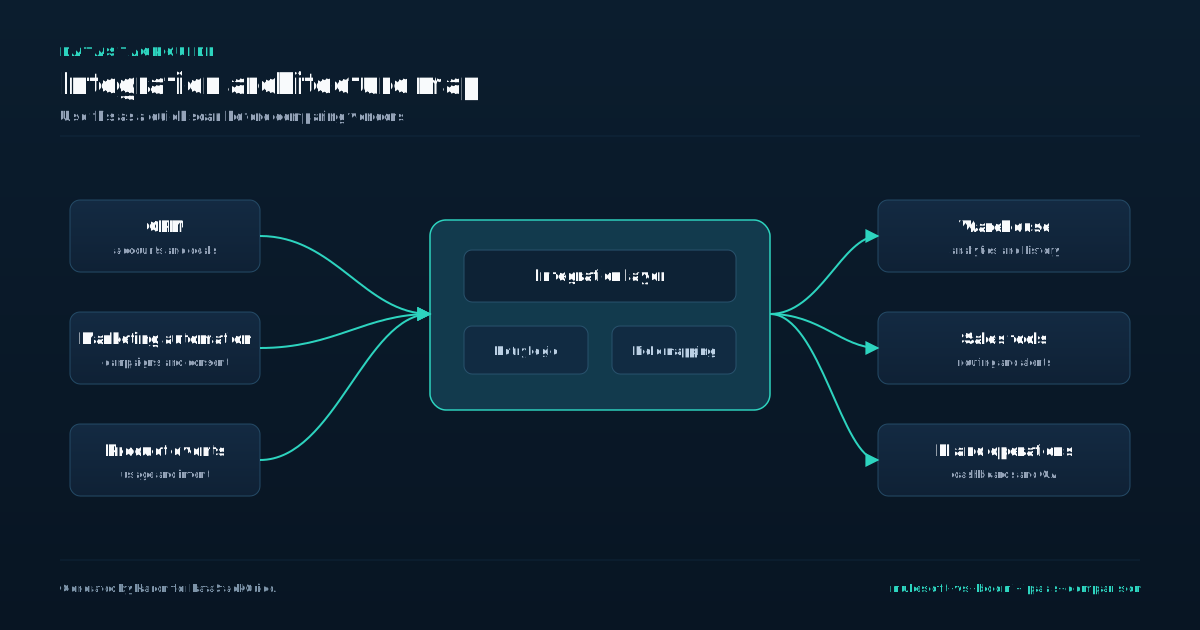
Where Workato Fits
Workato is the workflow-automation alternative buyers raise alongside this group. It sits a tier up from Zapier in complexity and a tier below MuleSoft in raw integration power, aimed at business-technologist teams automating processes across SaaS apps. It appears more frequently in our job postings than Boomi, which signals real adoption in the mid-market.
- Pick Workato over MuleSoft or Boomi when your work is process automation across cloud apps rather than heavy transactional or API-led integration.
- Pick MuleSoft or Boomi when you need enterprise-grade throughput, API management, or deep on-premises connectivity that workflow tools were not built for.
- Where Workato gets attractive is governance without heavyweight integration architecture.
RevOps, marketing ops, and finance ops teams can build automations without waiting on a central integration team, while IT still gets controls around credentials, recipes, and deployment. That makes it a better fit for process automation than for deep system modernization.
If the work involves high-volume APIs, event streams, or complex reuse across business units, Workato will start to feel constrained next to MuleSoft. If the work is quote-to-cash handoffs, lead routing, lifecycle campaigns, or finance approvals, it may be the cleaner operational choice.
Which One to Choose
Standardize on Salesforce and building an API program: MuleSoft, if you can staff it. Want broad connectivity fast without a large engineering team: Boomi. Integration sits next to analytics and data pipelines: SnapLogic, if the thinner ecosystem is acceptable.
- Running a heavy Oracle estate: Oracle Integration Cloud.
- Data quality and MDM at scale are the real problem: Informatica.
- The most expensive mistake is buying for a tier you do not need.
Mostly automating SaaS-to-SaaS processes: Workato. A team that needs SaaS workflow automation should not be paying MuleSoft core pricing, and an enterprise running mission-critical transactional integration should not try to force a workflow tool to do it. Run the shortlist from requirements, not from brand familiarity.
Start with the systems that must connect, the volume each integration will move, the failure modes the business cannot tolerate, and the team that will own the platform after launch. Then score each vendor against that operating model. A strong MuleSoft team can make MuleSoft look obvious.
A small operations team without dedicated developers may get more value from Boomi or Workato. A data platform team solving quality and governance problems may need Informatica before it needs another app connector. The right answer is the platform your team can run cleanly for three years, not the one with the largest feature grid.
Evaluation Workflow for iPaaS Shortlists
A useful iPaaS evaluation starts with an integration inventory. List every source system, destination system, data object, sync direction, frequency, owner, and failure impact. Separate batch movement from real-time workflows and API exposure.
- MuleSoft tends to look stronger when reusable APIs and centralized governance matter.
- Boomi tends to look stronger when the buyer needs broad application connectivity and faster implementation.
- SnapLogic and Informatica become more relevant when the same program includes data pipelines, transformation, or governance.
Workato becomes more relevant when the work is business process automation across SaaS tools. After the inventory, run a proof of concept on a real workflow rather than a vendor demo scenario. Pick one integration with authentication complexity, one with transformation complexity, and one with monitoring or retry requirements.
Ask each vendor to show how errors are surfaced, how credentials are managed, how changes are promoted, and how a non-happy-path incident is diagnosed. That exercise exposes more than a feature checklist.
Pricing and Staffing Checks Before You Buy
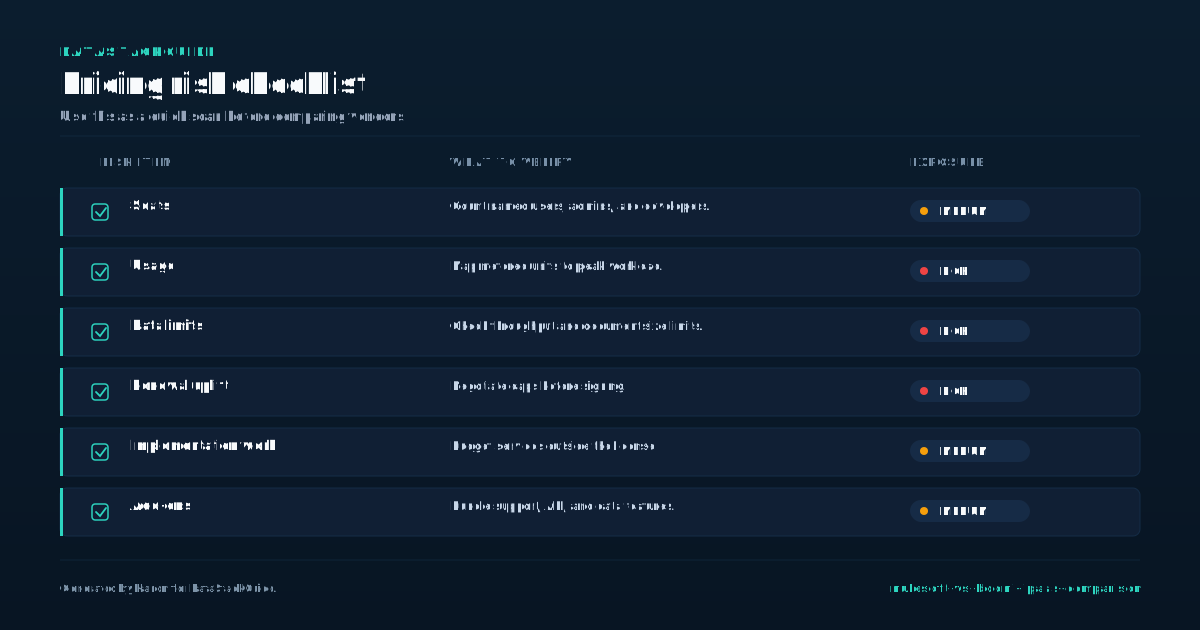
Pricing needs to be modeled alongside staffing. MuleSoft may carry the highest subscription and implementation cost, but the larger talent pool can reduce hiring risk for enterprises that already run Salesforce heavily. Boomi may start lower and deploy faster, but connector counts, environments, and support tiers can change the renewal picture.
- SnapLogic, Informatica, Oracle Integration Cloud, and Workato each have their own packaging logic, so compare them against the same integration inventory rather than the same vendor-provided bundle.
- The staffing question is just as important as the invoice.
- Who will build the first integrations, who will own production incidents, who will monitor sync health, and who will change mappings when the CRM or ERP schema changes?
If those answers are vague, the cheapest platform can become the most expensive one. A good shortlist document should include subscription cost, services cost, internal owner, expected implementation timeline, support path, and renewal risk.
Tools Mentioned in This Guide
Related Categories
Sources
Frequently Asked Questions
What is the difference between Boomi and MuleSoft?
Both are iPaaS platforms that connect business applications, but they target different buyers. MuleSoft (owned by Salesforce) is an API-led platform built for developers, strong in API lifecycle management and high-throughput integration, and it carries premium pricing.
Boomi takes a lower-code visual approach through its AtomSphere designer, ships faster, and bundles master data management. MuleSoft suits organizations standardizing on Salesforce and building an API program; Boomi suits teams that want broad connectivity without a large engineering investment.
MuleSoft also has a far deeper talent market, appearing in 784 of our over a million job postings versus 178 for Boomi.
Is MuleSoft or Boomi more expensive?
MuleSoft is generally more expensive. It prices by compute 'cores' and serious deployments commonly run a premium annual budget to a much larger annual budget per year once you add API management and support.
Boomi prices by connections and environments, and real deployments often start in the a lower but still negotiated annual budget, though heavy connector counts raise that. Neither publishes clean public pricing, so both numbers are negotiated and vary by deal.
How do MuleSoft and Boomi compare to SnapLogic?
SnapLogic sits between MuleSoft's developer depth and Boomi's accessibility, with a visual pipeline builder and a strong story for blending application and data integration. It fits teams that need analytics-and-app integration in one tool.
The trade-off is ecosystem size: SnapLogic appears in only 19 of our job postings against 784 for MuleSoft and 178 for Boomi, so the talent pool and partner network are far thinner.
Should I pick Oracle Integration Cloud instead of MuleSoft or Boomi?
Choose Oracle Integration Cloud (OIC) if you run a heavy Oracle estate (Fusion, ERP Cloud, NetSuite). Its prebuilt Oracle adapters cut integration time sharply inside that ecosystem.
Outside the Oracle stack, OIC loses its advantage and MuleSoft or Boomi usually fit better. The Dell Boomi vs MuleSoft vs OIC decision almost always comes down to how much of your stack is Oracle.
When is Informatica a better choice than MuleSoft or Boomi?
Informatica wins when your core problem is data management rather than application wiring. Its Intelligent Cloud Services platform is strongest where integration sits next to data quality, master data management, and large-scale ETL.
If you are moving and governing big data volumes, Informatica fits. For pure application-to-application integration, MuleSoft or Boomi are simpler and usually cheaper to run.
How does Workato fit against these enterprise iPaaS tools?
Workato is a workflow-automation platform aimed at business-technologist teams automating processes across SaaS apps. It sits above Zapier in complexity and below MuleSoft in raw integration power.
It appears more frequently in our job postings than Boomi, signaling solid mid-market adoption. Pick Workato for SaaS-to-SaaS process automation; pick MuleSoft or Boomi for enterprise throughput, API management, or deep on-premises connectivity.